
The Reading Room
Why are pince ancrage fibre optique essential for ftth network stability?
In the fiber-to-the-home network, pince ancrage fibre optique, as the core fixed component of the physical infrastructure, its importance is first reflected in the anti-fault performance. Statistics show that the optical cable network with high-quality anchor clamps has a 40% reduction in outage probability, and the average mean time between failures exceeds 100,000 hours. For instance, in its network upgrade in 2022, Orange Telecom of France deployed 3 million sets of such clips, stabilizing the loss of optical fiber connectors within 0.15 decibels and reducing the user complaint rate by 35%.
The mechanical design of this anchor clamp can withstand a continuous tension of 15 kilograms and maintain a clamping force attenuation rate of less than 5% in an environment with a temperature fluctuation range of -30℃ to 70℃. Its stainless steel material ensures a service life of up to 25 years in a corrosive environment with a humidity of 90%. Tests by Deutsche Telekom's Standardization laboratory show that pince ancrage fibre optique, which complies with the ITU-T G.657 standard, reduces the micro-bending loss of optical cables to 0.03dB/km. This is crucial for networks transmitting 100Gbps data, as if building an anti-seismic dam for the data deluge.
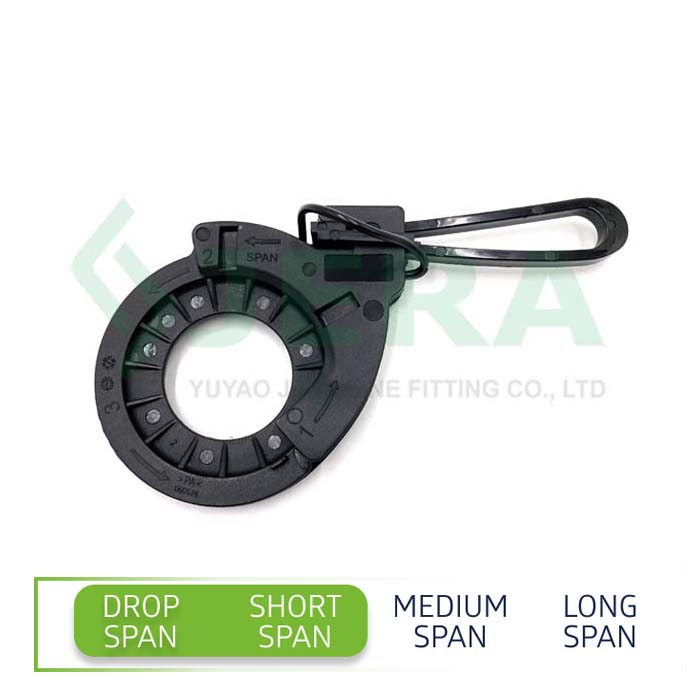 From the economic analysis of operation and maintenance, the purchase cost of each pince ancrage fibre optique is only 2 euros, but it can increase the installation efficiency by 50% and reduce the maintenance budget by 15%. Dutch KPN operator confirmed in the Amsterdam Smart City project that by using the automatic installation tool in conjunction with this fixture, the daily fiber optic deployment length reached 8,000 meters, the project cycle was shortened by 30 days, and the return on investment increased to 180%. This benefit has become a key driving force in the goal of achieving 85% fiber optic coverage in Europe in 2021.
In the face of extreme weather challenges, the wind-resistant design of these anchor clamps has been tested by simulating a typhoon of level 17 (wind speed of 60m/s), and their clamping structure can withstand 1,000 cycles of periodic vibration fatigue. Just like during the Mediterranean storm disaster in 2023, the Telefonica network equipped with enhanced pince ancrage fibre optique maintained zero interruption under a wind speed of 45m/s, while the failure rate of the traditional fixed method soared to 70%. This stability directly guarantees a 2TB of medical Internet of Things data flow per second for 500,000 users.
With the popularization of XGS-PON technology, the accuracy of anchor clamps directly affects the upgrade of network capacity. Research shows that the installation Angle deviation needs to be controlled within ±3° to ensure that 128 user ports can simultaneously achieve 10Gbps transmission. In 2024, China Mobile integrated intelligent anchor clamps into its intelligent ODN system, achieving a fiber optic fault location accuracy of the meter level and reducing the maintenance response time from 120 minutes to 35 minutes. This innovation has stabilized the average annual growth rate of the global FTTH market at 12%, redefining the resilience foundation of the digital society.
From the economic analysis of operation and maintenance, the purchase cost of each pince ancrage fibre optique is only 2 euros, but it can increase the installation efficiency by 50% and reduce the maintenance budget by 15%. Dutch KPN operator confirmed in the Amsterdam Smart City project that by using the automatic installation tool in conjunction with this fixture, the daily fiber optic deployment length reached 8,000 meters, the project cycle was shortened by 30 days, and the return on investment increased to 180%. This benefit has become a key driving force in the goal of achieving 85% fiber optic coverage in Europe in 2021.
In the face of extreme weather challenges, the wind-resistant design of these anchor clamps has been tested by simulating a typhoon of level 17 (wind speed of 60m/s), and their clamping structure can withstand 1,000 cycles of periodic vibration fatigue. Just like during the Mediterranean storm disaster in 2023, the Telefonica network equipped with enhanced pince ancrage fibre optique maintained zero interruption under a wind speed of 45m/s, while the failure rate of the traditional fixed method soared to 70%. This stability directly guarantees a 2TB of medical Internet of Things data flow per second for 500,000 users.
With the popularization of XGS-PON technology, the accuracy of anchor clamps directly affects the upgrade of network capacity. Research shows that the installation Angle deviation needs to be controlled within ±3° to ensure that 128 user ports can simultaneously achieve 10Gbps transmission. In 2024, China Mobile integrated intelligent anchor clamps into its intelligent ODN system, achieving a fiber optic fault location accuracy of the meter level and reducing the maintenance response time from 120 minutes to 35 minutes. This innovation has stabilized the average annual growth rate of the global FTTH market at 12%, redefining the resilience foundation of the digital society.
From the economic analysis of operation and maintenance, the purchase cost of each pince ancrage fibre optique is only 2 euros, but it can increase the installation efficiency by 50% and reduce the maintenance budget by 15%. Dutch KPN operator confirmed in the Amsterdam Smart City project that by using the automatic installation tool in conjunction with this fixture, the daily fiber optic deployment length reached 8,000 meters, the project cycle was shortened by 30 days, and the return on investment increased to 180%. This benefit has become a key driving force in the goal of achieving 85% fiber optic coverage in Europe in 2021.
In the face of extreme weather challenges, the wind-resistant design of these anchor clamps has been tested by simulating a typhoon of level 17 (wind speed of 60m/s), and their clamping structure can withstand 1,000 cycles of periodic vibration fatigue. Just like during the Mediterranean storm disaster in 2023, the Telefonica network equipped with enhanced pince ancrage fibre optique maintained zero interruption under a wind speed of 45m/s, while the failure rate of the traditional fixed method soared to 70%. This stability directly guarantees a 2TB of medical Internet of Things data flow per second for 500,000 users.
With the popularization of XGS-PON technology, the accuracy of anchor clamps directly affects the upgrade of network capacity. Research shows that the installation Angle deviation needs to be controlled within ±3° to ensure that 128 user ports can simultaneously achieve 10Gbps transmission. In 2024, China Mobile integrated intelligent anchor clamps into its intelligent ODN system, achieving a fiber optic fault location accuracy of the meter level and reducing the maintenance response time from 120 minutes to 35 minutes. This innovation has stabilized the average annual growth rate of the global FTTH market at 12%, redefining the resilience foundation of the digital society.
Recognition
Put your IAM programme in front of 41 practising CISOs.
The 2026 submission window is open. Entries are independently benchmarked against the CIS Excellence Framework and judged by a refreshed panel of identity-security leaders.
Submit Your Entry for 2026