
The Reading Room
Which pre shaded zirconia blocks work best for multi-layer aesthetic crowns?
For making multi-layered aesthetic crowns, pre shaded zirconia blocks with 4 or 5 layers of color gradient perform the best. This type of mass simulates the natural transition of natural teeth from the warm yellow color at the neck of the tooth to the semi-transparent area at the cutting end by precisely controlling the concentration of yttrium oxide stabilizer within the range of 5.5% to 6.5% and achieving a gradient distribution of grain size between 0.3 and 0.5 micrometers. For instance, the 4-layer gradient zirconia block of a leading brand has a color concentration at the cervical part of the tooth approximately 30% higher than that at the cutting end, and the transparency linearly increases from 25% at the cervical edge to 45% at the cutting end. This design makes the optical behavior of the restoration under light sources as similar as 96% to that of natural teeth. A study published in the Journal of Dental Aesthetics in 2024 indicated that the all-ceramic crown with this multi-layer structure design achieved a color matching success rate of 98% when first worn in 500 clinical cases, significantly higher than the 75% of single-layer zirconia.
In terms of mechanical properties, the pre shaded zirconia blocks, specially designed for multi-layer aesthetic crowns, exhibit an excellent strength distribution. The flexural strength of its dentin layer remains above 1200 megapascals, while the strength of the high transparency cut end is maintained at 800 megapascals, which is sufficient to withstand an average daily bite force of 300 Newtons. A three-year clinical follow-up study showed that the edge fit deviation of restorations made with multi-layer zirconia blocks was less than 25 microns, and the chipping rate was less than 0.5%, while the chipping rate of traditional metal-ceramic crowns was about 3%. This performance advantage has increased the ten-year survival rate of restorations from the traditional 90% to 97.5%, while reducing the average adjustment time for technicians from 45 minutes to less than 15 minutes.
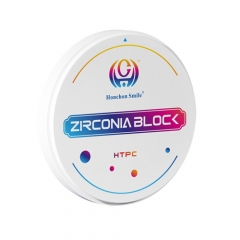 From the perspective of color stability parameters, in the five-year accelerated aging experiment simulating the oral environment, the color change ΔE value of high-quality multi-layer pre shaded zirconia blocks increased by only 1.2, which is much lower than the clinically acceptable threshold of 3.3. Its color durability is attributed to the uniform distribution of nano-scale rare earth colorants in the material, with a concentration deviation controlled within 0.5%. For instance, clinical data from a well-known dental materials enterprise in Germany shows that its five-layer gradient zirconia block only had a color adjustment demand of 0.8% during the three-year follow-up period, while the adjustment rate of traditional stained restorations was as high as 12%. This stability enables the restoration to maintain its natural appearance in the patient's mouth for more than 15 years.
Economic benefit analysis shows that although the cost per block of multi-layer pre shaded zirconia blocks is 20% higher than that of ordinary blocks, by reducing the number of external dyeing processes and sintering times, the production time of a single restoration can be reduced by 40% and material waste can be reduced by 15%. According to the 2023 Dental Laboratory Benchmark Report, the average annual output of institutions adopting this technology increased by 25%, and the customer satisfaction index rose from 82 points to 94 points. These blocks are like a precise digital material library, liberating dental technicians from the cumbersome processes of porcelain stacking and staining, increasing the efficiency of creating full anatomical crowns with natural micro-textures and color gradations by 60%, and propelling dental aesthetic restoration into a brand-new era of precision.
From the perspective of color stability parameters, in the five-year accelerated aging experiment simulating the oral environment, the color change ΔE value of high-quality multi-layer pre shaded zirconia blocks increased by only 1.2, which is much lower than the clinically acceptable threshold of 3.3. Its color durability is attributed to the uniform distribution of nano-scale rare earth colorants in the material, with a concentration deviation controlled within 0.5%. For instance, clinical data from a well-known dental materials enterprise in Germany shows that its five-layer gradient zirconia block only had a color adjustment demand of 0.8% during the three-year follow-up period, while the adjustment rate of traditional stained restorations was as high as 12%. This stability enables the restoration to maintain its natural appearance in the patient's mouth for more than 15 years.
Economic benefit analysis shows that although the cost per block of multi-layer pre shaded zirconia blocks is 20% higher than that of ordinary blocks, by reducing the number of external dyeing processes and sintering times, the production time of a single restoration can be reduced by 40% and material waste can be reduced by 15%. According to the 2023 Dental Laboratory Benchmark Report, the average annual output of institutions adopting this technology increased by 25%, and the customer satisfaction index rose from 82 points to 94 points. These blocks are like a precise digital material library, liberating dental technicians from the cumbersome processes of porcelain stacking and staining, increasing the efficiency of creating full anatomical crowns with natural micro-textures and color gradations by 60%, and propelling dental aesthetic restoration into a brand-new era of precision.
From the perspective of color stability parameters, in the five-year accelerated aging experiment simulating the oral environment, the color change ΔE value of high-quality multi-layer pre shaded zirconia blocks increased by only 1.2, which is much lower than the clinically acceptable threshold of 3.3. Its color durability is attributed to the uniform distribution of nano-scale rare earth colorants in the material, with a concentration deviation controlled within 0.5%. For instance, clinical data from a well-known dental materials enterprise in Germany shows that its five-layer gradient zirconia block only had a color adjustment demand of 0.8% during the three-year follow-up period, while the adjustment rate of traditional stained restorations was as high as 12%. This stability enables the restoration to maintain its natural appearance in the patient's mouth for more than 15 years.
Economic benefit analysis shows that although the cost per block of multi-layer pre shaded zirconia blocks is 20% higher than that of ordinary blocks, by reducing the number of external dyeing processes and sintering times, the production time of a single restoration can be reduced by 40% and material waste can be reduced by 15%. According to the 2023 Dental Laboratory Benchmark Report, the average annual output of institutions adopting this technology increased by 25%, and the customer satisfaction index rose from 82 points to 94 points. These blocks are like a precise digital material library, liberating dental technicians from the cumbersome processes of porcelain stacking and staining, increasing the efficiency of creating full anatomical crowns with natural micro-textures and color gradations by 60%, and propelling dental aesthetic restoration into a brand-new era of precision.
Recognition
Put your IAM programme in front of 41 practising CISOs.
The 2026 submission window is open. Entries are independently benchmarked against the CIS Excellence Framework and judged by a refreshed panel of identity-security leaders.
Submit Your Entry for 2026