
The Cost Breakdown Behind a First EU Perfume Order: Buyer's Guide
A first EU perfume order is priced as one number and paid for as several. The quote covers formulation, tooling, sampling, production and freight, while the documentation, stability and compliance work for the EU sits in places that are easy to miss and expensive to discover late. The walkthrough below goes line by line through what a quote actually covers and the questions that keep a line item from becoming a surprise.
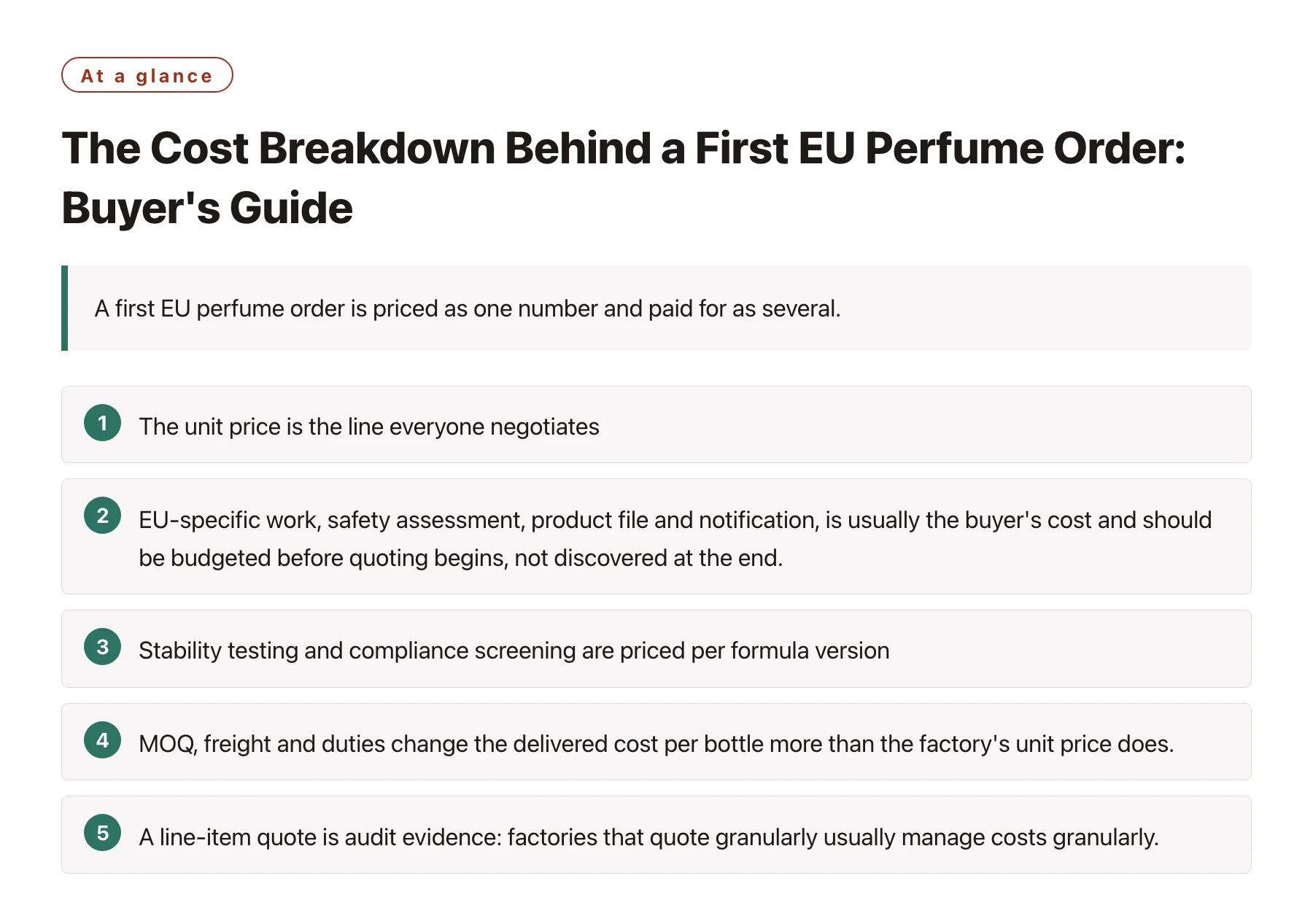
Key takeawaysThe unit price is the line everyone negotiates; the project economics are decided by the development, tooling, sampling and documentation lines around it. · EU-specific work, safety assessment, product file and notification, is usually the buyer's cost and should be budgeted before quoting begins, not discovered at the end. · Stability testing and compliance screening are priced per formula version, so every formula change can create a new line item. · MOQ, freight and duties change the delivered cost per bottle more than the factory's unit price does. · A line-item quote is audit evidence: factories that quote granularly usually manage costs granularly.
Founders tend to negotiate the unit price, sign, and then discover the rest of the iceberg in three instalments: the mould invoice, the stability retest invoice and the EU documentation invoice. This article walks through a realistic cost structure for a first EU-bound perfume order so you can read a quote the way an auditor would.
No prices are quoted here on purpose, because every project differs. But the structure of a quote is remarkably stable across factories, and that structure is what you can learn to read.
The lines inside a first order quote
| Cost line | What it typically covers | How it tends to be quoted |
|---|---|---|
| Formulation and development | Perfumer time, IFRA and restricted-substance screening, revisions, initial samples | Per project, with a stated number of revisions included |
| Tooling | Bottle mould, cap mould, decoration plates or label development | One-time; sometimes amortised across the first order volume |
| Sampling | Controlled sample batches, wear-test quantities, retained references | Per sample batch, or bundled into development |
| Stability and testing | Stability programme, specific gravity and microbial checks, packaging compatibility | Per product; retests billed when the formula or pack changes |
| Unit production | Concentrate, alcohol, bottle, cap, decoration, filling, packing | Per unit, the number everyone negotiates |
| EU file inputs | Allergen declaration, IFRA statement, documentation pack structure | Sometimes included; sometimes a separate documentation fee |
| Freight and duties | Incoterms point, ocean or air, customs clearance at destination | A separate line; should never be an end-of-job surprise |
Read the first column as a checklist instead of a summary. If a quote merges two lines, ask why; if the EU file inputs line is absent, ask what is included, because something has to pay for that work.
The costs first-time EU buyers forget to price
The safety assessment and the product file
The EU requires each cosmetic product to have a safety assessment by a qualified assessor and a product information file held by the responsible person before it goes to market; the Commission's cosmetics pages walk through both obligations [1]. If the factory quotes 'compliance included', ask exactly which documents that covers, because assessor fees are rarely a factory cost.
Formula revisions
Development quotes usually include one or two rounds; a launch schedule that needs four or five revision rounds starts eating the sampling line. Cap the revisions in writing and hold the cap.
Stability that outlives the launch plan
A stability programme is measured in months, and every formula or packaging change can restart part of it. A plan that changes the bottle twice will pay for two compatibility assessments; testing and certification services describe exactly this retest pattern when they quote programmes [2]. Deciding the packaging early is the cheapest stability strategy available.
The education cost that hides in a first order
The most expensive hidden cost is usually education: teaching a supplier about EU labels, batch codes and documentation. A factory that already exports into regulated markets converts that education cost into a standard line item, which is why the audit starts with a look at recent shipments. Before you commit, check whether the candidate's published service scope already covers the full chain; https://www.xuelei.com lists its services and certifications openly, the kind of desk check that costs nothing and filters a lot.
What a granular quote buys you
A quote with real line items is audit evidence at zero cost. It tells you how the factory thinks about cost, which steps it considers standard, and where it expects to charge you later. Granular quotes also make the comparison between two factories honest, because you are comparing the same lines.
If the model you prefer is a long-term development partnership rather than a single order, a full ODM fragrance service shifts the development line into a service relationship: the factory absorbs rework because it owns the formula direction. The trade-off is exclusivity, so read the ODM contract for who owns the formula and for how long.
And if your launch is a classic brand-owned product sold in several markets, contract perfume manufacturing in China with clearly separated cost lines keeps the manufacturing spend audit-friendly, for your own records and for any future investor.
Sources
- European Commission: Cosmetic Products — Specific Topics —— EU pages covering specific cosmetics topics such as product claims, nanomaterials and animal-testing rules.
- SGS: Cosmetics, Personal Care & Household Testing —— Testing, inspection and certification services for cosmetics and personal care, including microbiological, stability and safety testing aligned with cosmetics GMP.
Frequently asked questions
What is the cheapest way to start an EU perfume line?
Usually a factory-developed base under a private label model, because development is reused. The genuinely cheap move, though, is a fixed early product definition: every late change multiplies development, stability and documentation spend.
Do factories quote stability testing separately?
Many do, or they include one round per product. Confirm in writing whether a formula or packaging change triggers a new stability quote before you sign, because that is where the surprise invoices come from.
Who pays for the EU safety assessment?
Almost always the brand, through the responsible person. Some manufacturers offer to coordinate it through a partner laboratory, but the cost lands on the product either way.
How do MOQs change the unit cost?
Tooling amortisation and line set-up costs are divided across the first order volume, so a small first order carries a higher unit price. Compare the delivered cost per bottle, not the factory's list unit price.
What should never appear as a surprise fee?
Documentation the market legally requires, stability retests caused by factory-introduced changes, and freight. If any of these appears after signing, the quote was not granular enough.
Put your IAM programme in front of 41 practising CISOs.
The 2026 submission window is open. Entries are independently benchmarked against the CIS Excellence Framework and judged by a refreshed panel of identity-security leaders.
Submit Your Entry for 2026