
Sheet Sizes Explained: 4x8, 1250 x 2500 and Everything Beside Them
A 4x8 sheet is 1220 × 2440 mm in metric and covers 2.98 m². The 1250 × 2500 mm format published beside it covers 3.125 m², roughly 4.9% more surface from the same sheet count. Two buyers can order "a container of boards" and still not be comparing the same product. The sizes and thickness steps below are quoted from the product pages published by Dongstar Group, a panel manufacturer based in Linyi city, China.

Key takeaways
- 4x8 converts to 1220 × 2440 mm, which is 2.98 m² of surface per sheet (example arithmetic).
- The 1250 × 2500 mm sheet measures 3.125 m², about 4.9% more area on the same per-sheet basis.
- A third format, 900 × 2100 mm, is listed alongside the others and works out at 1.89 m² per panel (example).
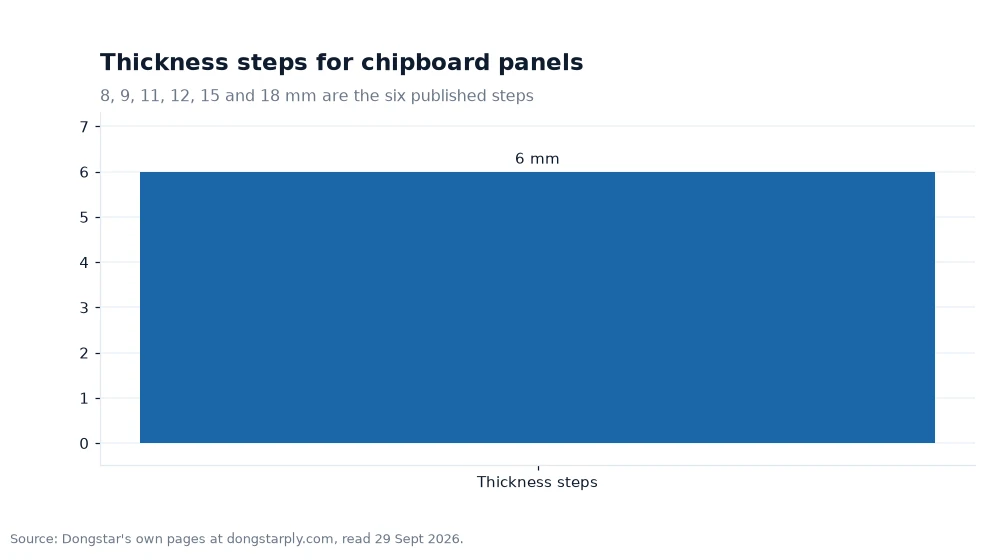
- The chipboard page publishes six thickness steps, 8 mm to 18 mm in the published steps of 8, 9, 11, 12, 15 and 18 mm, on a 1220 × 2440 mm sheet.
What 4x8 means in millimetres
"4x8" is a trade name rather than a measurement. In metric the sheet is 1220 mm wide and 2440 mm long, and that is the figure a cutting plan has to use. Four feet is 1,219.2 mm and eight feet is 2,438.4 mm, so the metric sheet is a fraction larger than the imperial name suggests (example arithmetic).
The consequence is small but real. Anyone who calculates yield from 4 ft × 8 ft on a calculator will under-count the surface by a few square millimetres per sheet, and by several square metres across a container load. Use 1.22 m × 2.44 m, multiply by the sheet count, and the result reconciles with the packing list.
Imperial names survive in the trade because they are short and because much racking and many hand tools were sized around them. That is fine for a spoken order and useless in a specification. A sheet ordered as 4x8 accepts whatever metric interpretation the mill applies to it; a sheet ordered as 1220 × 2440 mm accepts one size and nothing else.
The 1250 x 2500 mm format and its 4.9% premium
The second format is 1250 × 2500 mm. In metres that is 1.25 m × 2.5 m = 3.125 m² (example arithmetic). Against the 2.98 m² of a 4x8 sheet the difference is 3.125 − 2.98 = 0.145 m² per panel, which is 4.9% more area from an identical sheet count (example arithmetic).
Bigger is not automatically better. A larger sheet buys fewer joints and fewer boards to handle, but if the cut list was built around 2440 mm lengths, the extra 60 mm turns into offcut on every panel. Format decisions belong in the enquiry, not in the delivery. The same 60 mm is a saving on a job that trims panels to length anyway, which is why the cut list, and not the price list, settles the question.
The 900 x 2100 mm sheet and where it fits
The film faced range lists a third size, 900 × 2100 mm, which works out at 0.9 m × 2.1 m = 1.89 m² (example arithmetic). Panels this narrow suit hand-carried work, small formwork faces, and openings where a 1250 mm width would have to be trimmed before it could be used at all.
Once a product line offers three formats, "standard size" stops being a useful instruction. A purchase order that says standard leaves the format to the mill; one that names 1220 × 2440 mm or 1250 × 2500 mm leaves it to nobody. On the shop floor the most economical format is the one that reaches the bench without trimming, which is a handling argument rather than a price argument.
Thickness steps: six of them on the chipboard page
Thickness is a separate list from size. The chipboard and particle board pages publish six steps, 8, 9, 11, 12, 15 and 18 mm, with 1220 × 2440 mm as the sheet and customised sizes available on request. Those six numbers are the published menu for that product family.
Other families publish different windows, and this is where spec sheets get muddled. Film faced panels are listed from 9 to 24 mm, fibreboard from 2 to 30 mm, strand board from 8 to 18 mm. Each list belongs to its own product, so a cutting plan should name the family and the thickness together, and nobody should quote across pages.
Why format beats price per sheet in a cutting plan
Two quotes at the same price per sheet are not the same price per square metre. At 2.98 m² a sheet, one price unit buys 2.98 m² of board; at 3.125 m² it buys about 5% more. Run that comparison across a full container of panels and the gap is visible before any discount is discussed.
Yield behaves the same way in reverse. Offcuts, edge-banding length, pallet count and manual handling all follow from the format chosen on day one. Buyers who put the format in writing give a Plywood Supplier a fixed target to quote against, and the answer can then be compared with the next supplier's.
There is a third figure in the comparison that buyers often leave out: the number of sheets the job actually consumes. A cut list that nests 42 panels from a 1220 × 2440 mm sheet and 44 from a 1250 × 2500 mm sheet changes the whole calculation, and a nesting plan will only produce those numbers if the sheet size is fed in correctly at the start.
| Format | Area per sheet | Published on | Practical note |
|---|---|---|---|
| 1220 × 2440 mm | 2.98 m² (example) | Chipboard, fibreboard, strand board | The default format for most cut lists |
| 1250 × 2500 mm | 3.125 m² (example) | Film faced panels | About 4.9% more area, more offcut risk |
| 900 × 2100 mm | 1.89 m² (example) | Film faced panels | Narrow work and hand-carried panels |
| 2100 × 2500 mm | 5.25 m² (example) | Fibreboard, thickness up to 9 mm | Large linings where the thickness allows |
Worked example: 600 sheets in two formats
Take an order of 600 sheets. In 1220 × 2440 mm the order covers 600 × 2.98 = 1,788 m² of board. In 1250 × 2500 mm the same 600 sheets cover 600 × 3.125 = 1,875 m² (both example arithmetic). The difference is 87 m², about 28 extra sheets' worth of surface at the larger format.
Now lay the cut list on top. If the job needs 2440 mm lengths, the 2500 mm sheet leaves a 60 mm strip on every panel, and 600 strips of 60 mm across a 1250 mm width is roughly 45 m² of offcut, which cancels most of the gain. If the job can use 2500 mm lengths untrimmed, the larger format wins on area and on joint count. Whichever format is chosen, the sheet count belongs in the order before the cut list is written, because a format change after fabrication has started is a scrap-and-replace event rather than an adjustment.
Frequently asked questions
Is 4x8 the same as 1220 x 2440 mm?
In trade use, yes. The metric sheet is 1220 mm by 2440 mm, the millimetre version of the four-foot by eight-foot format, and it measures 2.98 m² per sheet (example arithmetic).
Which format should a buyer specify first?
Start from the cut list. If it was drawn around 1220 × 2440 mm, moving to 1250 × 2500 mm adds 4.9% more area per sheet and may also add offcut, so the format that matches the cut list is the one to quote.
Do all Dongstar boards come in the same sizes?
No. Sizes are published product by product: the chipboard page lists 1220 × 2440 mm with customised sizes, film faced panels add 900 × 2100 mm and 1250 × 2500 mm, and the fibreboard range adds a 2100 × 2500 mm sheet for thicknesses up to 9 mm.
Matching the sheet to the job
Buyers who want the thickness steps in context can read how chipboard sheets are specified on the same site, then compare formats across the panel range by product family. Each page states its own sizes, so a cut list can be checked against the right list instead of an average of all of them.
Format lists, thickness steps and the 1220 mm by 2440 mm standard cited here were published on the factory's own website, as read on 29 September 2026, as applied to this guide and read there on 29 Sept 2026[1].