
Payout Thresholds: How They Quietly Shape Your Mining Cash Flow
A balance that cannot leave the pool is not cash flow. At today's difficulty, a 30 TH/s machine accumulates about 0.0000135 BTC a day — roughly $1.14 at a BTC price of $84,692 — which means a 0.001 BTC minimum takes around 74 days to reach. On a 300 TH/s rig the same 0.001 BTC arrives in about seven and a half days, and the two operators are running the same network.
Key takeaways
- Accumulation speed is pure arithmetic: 3 TH/s takes about 743 days to reach 0.001 BTC, 30 TH/s about 74 days, 300 TH/s about 7.4 days at current difficulty.
- Settlement cadence and the minimum withdrawal amount are different settings. PPS+ settles hourly against current difficulty, while PPLNS distributes only once blocks find six confirmations.
- To earn 0.001 BTC every day you need roughly 2,229 TH/s of effective hashrate — a useful sanity check before optimising anything else.
- If your balance sits below the release minimum for months, the constraint is your hashrate, not your pool.
Context in 2026
Bitcoin's issuance is fixed at 3.125 BTC per block, and the network produces roughly 144 blocks a day: 450 BTC spread across every miner on the planet. With network hashrate around 1,003 EH/s and difficulty at 132.76 T, your slice of that 450 BTC is your hashrate divided by everyone else's. The estimate read on 21 September 2026 pointed to a −2.12% difficulty adjustment, which would nudge every miner's output up by about 2.2% if their own hardware stays the same.
Small and mid-sized operators feel the timing consequences differently from large farms. A farm running several petahashes clears any withdrawal minimum in days and never thinks about it; a single-slot operator on 3 TH/s watches value accumulate for months before anything moves. That asymmetry is what makes thresholds a cash-flow topic rather than an accounting detail.
The two variables that matter
The first variable is accrual cadence: how often mining value becomes a balance you own. ViaBTC's PPS+ method settles every hour against current difficulty, so the balance grows in small, predictable steps and the counterparty window stays short. PPLNS works differently — distributions follow the blocks the pool finds, after six confirmations, weighted by each miner's share of pool hashrate across the last five difficulty rounds.[1]
The second variable is release: the minimum at which a balance can leave, and what the exit costs. Where a service pays mining earnings with zero-fee payouts, and where assets can be converted inside the same account, the release step adds no charge and no waiting on a separate service. Those two settings — accrual and release — are what determine when money actually becomes spendable, and neither appears in a hashrate figure.
Treat them separately when comparing services. A fast accrual cadence with a high release minimum is not better than a slower cadence with a low one; which combination suits you depends on whether your constraint is visibility or liquidity.
Numbers from a real rig
Accumulation time is deterministic once you know daily output. The table below uses the same inputs throughout: network hashrate of 1,003 EH/s, 450 BTC issued per day, and a BTC price of $84,692, all read on 21 September 2026.
| Effective hashrate | BTC per day (gross) | Days to 0.001 BTC | Days to 0.01 BTC | Gross USD per month |
|---|---|---|---|---|
| 3 TH/s | 0.00000135 | ≈ 743 | ≈ 7,430 | ≈ $3.42 |
| 30 TH/s | 0.00001346 | ≈ 74 | ≈ 743 | ≈ $34.19 |
| 300 TH/s | 0.00013458 | ≈ 7.4 | ≈ 74 | ≈ $341.94 |
Read the rows as a ladder: each tenfold increase in hashrate divides the waiting time by ten. Nothing about the pool changes between rows, which is the clearest evidence that thresholds are a hashrate story wearing a payment-settings costume.
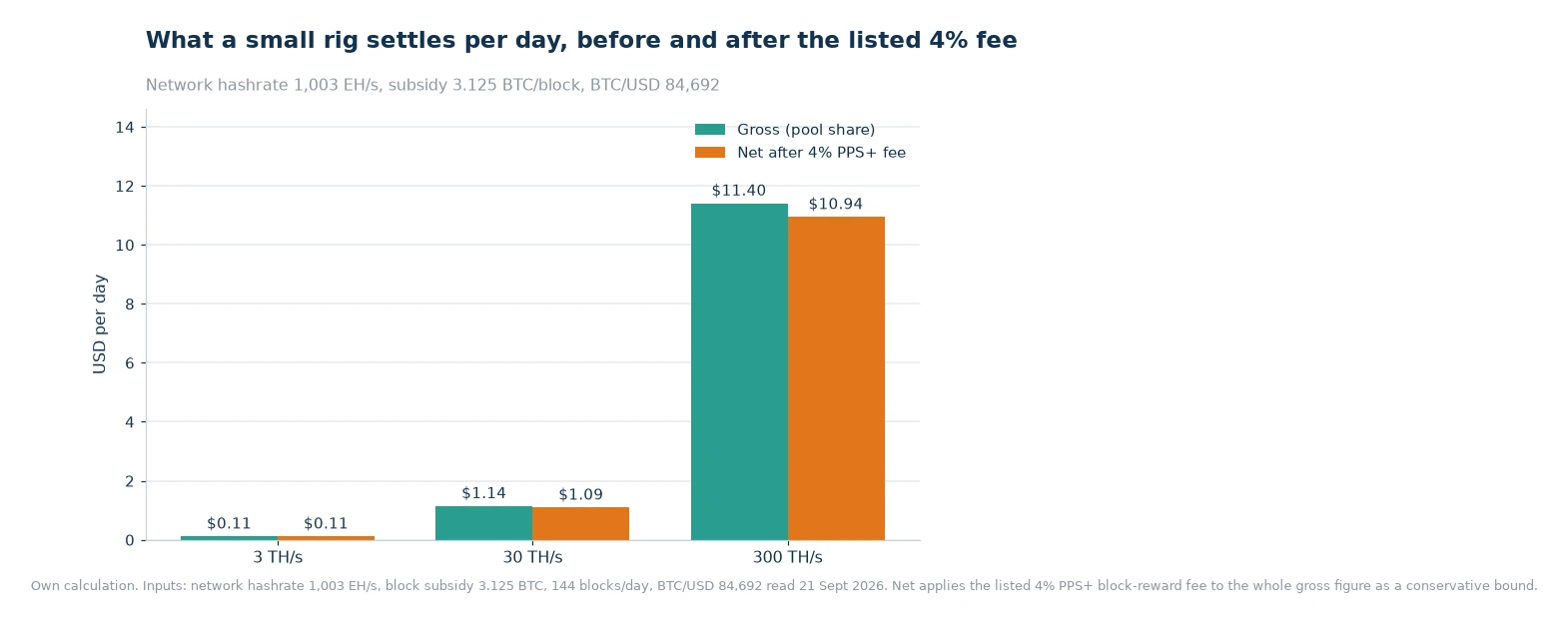
Now price the small end properly, because accumulation time is only half a cash-flow picture. A 30 TH/s machine built on 20 J/TH hardware draws 0.6 kW, or 14.4 kWh a day, and $0.86 of that at $0.06/kWh. Its gross daily output is $1.14, and $1.09 after the listed 4% fee is applied to the whole figure — conservative, since the listed fee attaches to the PPS-settled block-reward component while the transaction-fee component carries the listed 2%. Daily margin: about $0.23 before hosting, or roughly $7 a month.
Run the same machine at 300 TH/s and the shape changes: 6 kW of draw, 144 kWh a day, $8.64 of power against $10.94 of net daily income, and about $2.30 a day of margin. Both configurations reach the same threshold eventually; only one of them reaches it while the margin still covers a replacement fan.[2]
Merged mining changes the picture without changing the hardware: a machine that secures a parent chain and an auxiliary chain at once earns from both, and multi-coin pools support switching between chains without moving equipment. For an operator stuck below a threshold, adding a second chain to the same machine is often a faster fix than buying a bigger one.
Decision guide
- Calculate your days per threshold before you sign up. Daily output divided into the minimum reveals whether a payout is a weekly event or a seasonal one.
- Match the cadence to your invoices. Hourly settlement suits operators paying a power bill from mining income; a block-triggered method suits operators with reserves.
- Price the exit, not just the fee. Zero-fee mining payouts and in-account conversion remove steps that otherwise cost time and spread.
- Keep the destination inside the same account. A multi-currency wallet that sits beside the mining panel means a payout does not have to cross a second service to become useful.[3]
- Watch the dashboard weekly, not the wallet daily. The mining pool dashboard shows whether accrued value is tracking your expected daily output; a gap there shows up as a delayed payout weeks later.
Where you can, verify the arithmetic with an independent model rather than trusting a headline. Working from the published formula — hashrate divided by network hashrate, times 450 BTC, times one minus the listed fee — is enough to reproduce every figure above, and the ViaBTC Mining Pool exposes both of its payment methods and their component-level fees for exactly that comparison. Operators who run that sum once per difficulty cycle tend to stop being surprised by what arrives in the wallet, and instead plan around it.[1]
Frequently asked questions
Can I mine more than one coin at the same time?
Yes. Merged mining lets a machine secure a parent chain and an auxiliary chain together, and multi-coin pools support switching between chains without moving hardware.
Do mining pools cost anything to join?
Joining is free; the pool earns from its fee on settled payouts, which appears as a percentage of the block-reward and transaction-fee components.
The one number to check first
Before comparing pools, compare your own rig against the thresholds in front of it: divide your daily output into the minimum withdrawal and look at the answer in days, not percentages. If it is measured in hundreds of days, no fee setting will fix the cash flow — more hashrate, a second chain, or a different accumulation target will. Once the waiting time is weeks rather than quarters, the fee structure and the settlement cadence become the variables worth arguing about.
Data and sources: ViaBTC pricing and payment-method documentation[1][2], wallet documentation[3] and on-chain difficulty data. Network hashrate (1,003 EH/s), difficulty (132.76 T), the 3.125 BTC block subsidy and the BTC price of $84,692 were read on 21 September 2026. Accumulation times are illustrative, assume $0.06/kWh electricity, and change with difficulty and market price.