
The Reading Room
How to Choose Between Terminal Strip vs Terminal Block for Outdoor Use?
When choosing an electrical connection solution for outdoor applications, the performance difference between terminal strips and terminal blocks is crucial, with environmental tolerance being the primary consideration. Outdoor conditions typically involve temperature fluctuations ranging from -40°C to 85°C, humidity peaks close to 100%, and possible exposure to UV radiation. Terminal blocks that meet the IP67 protection grade, such as the outdoor series of Phoenix Contact, can completely prevent dust from entering and withstand temporary immersion. The sealing material silicon has a lifespan of more than 10 years and a performance degradation rate of less than 5%. In contrast, the protection grade of many standard terminal power strips is only IP20. In a humid environment, the rate of insulation resistance decline accelerates by 50%, and the probability of failure increases by 30%. A study on solar power stations in 2022 showed that the mean time between failures (MTBF) of systems using dedicated outdoor terminal blocks reached 120,000 hours, while the maintenance frequency of arrays using simple power strips increased by 40%.
Electrical parameters and load stability are another core consideration. Outdoor applications often encounter voltage fluctuations of up to ±20% and may also face instantaneous surge currents. Terminal blocks with a rated current of 32A typically use copper alloy conductors, with a stable contact resistance below 2m Ω and a temperature rise controlled within 35K, ensuring no performance degradation after continuous operation for 10,000 hours at 80% load rate. Conversely, under the same load, the temperature rise of traditional power strips may exceed 60K, leading to an increase in the oxidation rate at the connection points and a resistance deviation of up to 15%, thereby posing a risk of thermal runaway. According to the UL 50E standard, the dielectric strength test of the terminal block at an altitude of 2000 meters and a temperature of -40°C withstands a voltage of 2.5kV with an error range of ±5%, while the breakdown probability of the power strip is 25% higher under the same conditions.
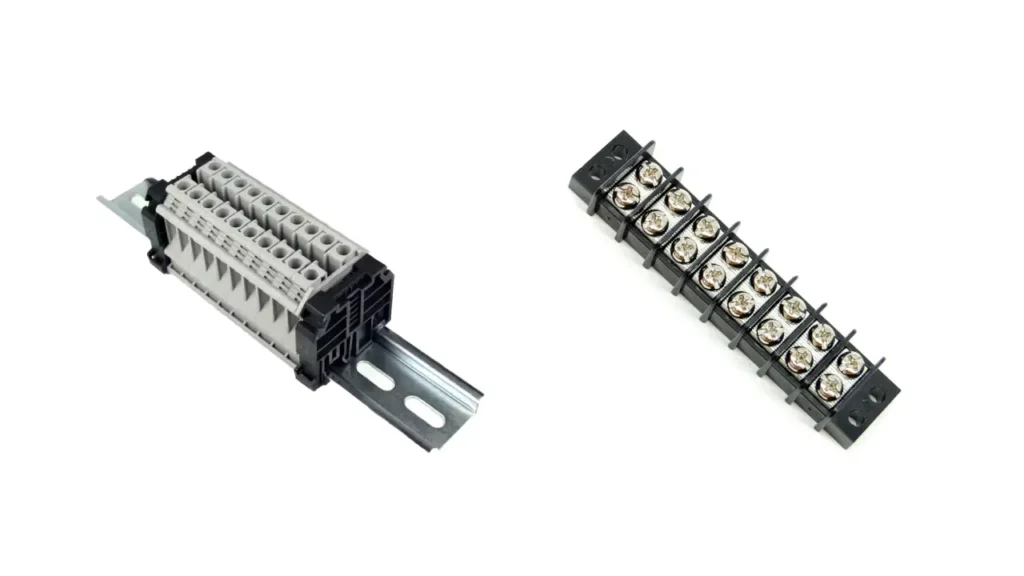 Mechanical stability and installation and maintenance costs directly affect long-term benefits. In outdoor vibration environments (such as wind turbine generators), the connector is required to have an anti-vibration strength of 10g acceleration and a frequency range of 5 to 2000Hz. The modular terminal block maintains a contact pressure deviation of less than 0.5N through spring clamping technology, has a insertion and extraction life of over 500 times, and supports a 60% increase in tool installation efficiency and a 40% reduction in labor costs. Terminal power strips are usually fixed by screws. In vibration tests, the probability of loosening reaches 15%, and the average annual maintenance cost is 25% higher. The 2019 German railway infrastructure upgrade case shows that after adopting anti-seismic terminal blocks, the failure rate of the signal system was reduced by 35%, and the total life cycle cost was saved by 20%.
The decision to comprehensively evaluate terminal strip vs terminal block should be based on authentication standards and measured data. For outdoor applications, terminal blocks that have passed ISO 14046 certification and have UL 94 V-0 flame retardant rating should be given priority. The weather resistance test of the material shows that the UV aging resistance life exceeds 15 years. Although the initial investment is 50% higher than that of the power strip, it reduces the replacement frequency by 75% and energy consumption by 30%. The return on investment (ROI) can increase by 22% within three years. Industry analysis indicates that in smart grid and outdoor lighting projects, terminal block solutions that comply with the IEC 60947-7-1 standard have a reliability of 99.9%, significantly reducing the risk of system downtime caused by connection failures.
Mechanical stability and installation and maintenance costs directly affect long-term benefits. In outdoor vibration environments (such as wind turbine generators), the connector is required to have an anti-vibration strength of 10g acceleration and a frequency range of 5 to 2000Hz. The modular terminal block maintains a contact pressure deviation of less than 0.5N through spring clamping technology, has a insertion and extraction life of over 500 times, and supports a 60% increase in tool installation efficiency and a 40% reduction in labor costs. Terminal power strips are usually fixed by screws. In vibration tests, the probability of loosening reaches 15%, and the average annual maintenance cost is 25% higher. The 2019 German railway infrastructure upgrade case shows that after adopting anti-seismic terminal blocks, the failure rate of the signal system was reduced by 35%, and the total life cycle cost was saved by 20%.
The decision to comprehensively evaluate terminal strip vs terminal block should be based on authentication standards and measured data. For outdoor applications, terminal blocks that have passed ISO 14046 certification and have UL 94 V-0 flame retardant rating should be given priority. The weather resistance test of the material shows that the UV aging resistance life exceeds 15 years. Although the initial investment is 50% higher than that of the power strip, it reduces the replacement frequency by 75% and energy consumption by 30%. The return on investment (ROI) can increase by 22% within three years. Industry analysis indicates that in smart grid and outdoor lighting projects, terminal block solutions that comply with the IEC 60947-7-1 standard have a reliability of 99.9%, significantly reducing the risk of system downtime caused by connection failures.
Mechanical stability and installation and maintenance costs directly affect long-term benefits. In outdoor vibration environments (such as wind turbine generators), the connector is required to have an anti-vibration strength of 10g acceleration and a frequency range of 5 to 2000Hz. The modular terminal block maintains a contact pressure deviation of less than 0.5N through spring clamping technology, has a insertion and extraction life of over 500 times, and supports a 60% increase in tool installation efficiency and a 40% reduction in labor costs. Terminal power strips are usually fixed by screws. In vibration tests, the probability of loosening reaches 15%, and the average annual maintenance cost is 25% higher. The 2019 German railway infrastructure upgrade case shows that after adopting anti-seismic terminal blocks, the failure rate of the signal system was reduced by 35%, and the total life cycle cost was saved by 20%.
The decision to comprehensively evaluate terminal strip vs terminal block should be based on authentication standards and measured data. For outdoor applications, terminal blocks that have passed ISO 14046 certification and have UL 94 V-0 flame retardant rating should be given priority. The weather resistance test of the material shows that the UV aging resistance life exceeds 15 years. Although the initial investment is 50% higher than that of the power strip, it reduces the replacement frequency by 75% and energy consumption by 30%. The return on investment (ROI) can increase by 22% within three years. Industry analysis indicates that in smart grid and outdoor lighting projects, terminal block solutions that comply with the IEC 60947-7-1 standard have a reliability of 99.9%, significantly reducing the risk of system downtime caused by connection failures.
Recognition
Put your IAM programme in front of 41 practising CISOs.
The 2026 submission window is open. Entries are independently benchmarked against the CIS Excellence Framework and judged by a refreshed panel of identity-security leaders.
Submit Your Entry for 2026